


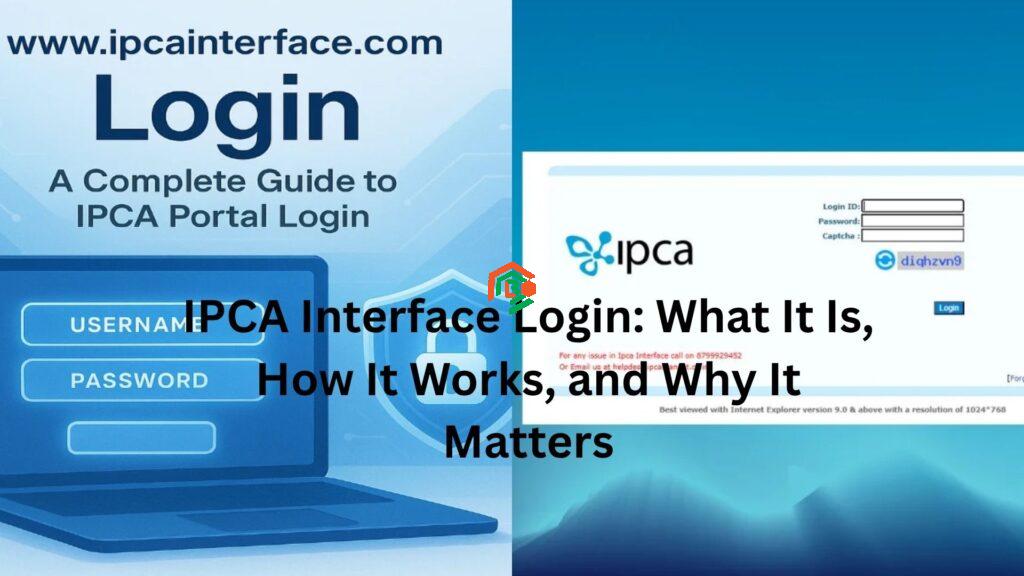
If you’ve ever tried to access a specialized financial or regulatory portal in India, you’ve probably come across something that felt a bit… clunky. Not broken, just not exactly user-friendly at first glance. The IPCA interface login is one of those systems.
At a glance, it looks straightforward: enter credentials, get access, move on. But once you start using it regularly—especially for compliance, reporting, or institutional workflows—you realize there’s more going on beneath the surface.
Let’s unpack it in a way that actually makes sense.
What the IPCA Interface Login Is Really About
The IPCA interface login isn’t just another generic login page. It’s typically tied to a structured platform used by institutions, often in financial or regulatory contexts, where secure access and controlled data entry matter a lot.
Think of it like this: it’s not built for casual browsing. It’s built for accountability.
Every login connects to a user role. That role determines what you can see, what you can edit, and what you’re responsible for. A junior staff member might only upload data. A senior officer might review and approve submissions. The login is the gatekeeper for all of that.
And yes, that’s why it can feel a bit rigid.
First Impressions Can Be Misleading
The first time someone lands on the IPCA interface login page, the reaction is often the same: “That’s it?”
No flashy design. No onboarding hints. Just fields for username and password, maybe a captcha, and a login button.
Here’s the thing—this simplicity is intentional. Systems like this prioritize stability and security over aesthetics. It’s not trying to impress you. It’s trying to avoid errors.
A colleague once described it perfectly: “It feels like logging into a vault, not an app.”
That’s not far off.
Getting Access: Not Always Instant
Unlike typical apps where you sign up and jump in, access to the IPCA interface usually isn’t immediate. It’s assigned.
You’ll often need:
- Authorization from your organization
- Registered credentials issued by an admin
- Sometimes an approval workflow before activation
This extra layer can feel slow, especially if you’re used to instant access platforms. But in regulated environments, it makes sense.
Imagine a scenario where anyone could just create an account and start submitting official data. That would spiral into chaos pretty quickly.
The Login Experience: Small Frictions That Add Up
Once you have credentials, the login itself is usually straightforward—but not always smooth.
You might run into things like:
- Password rules that are stricter than expected
- Session timeouts that log you out mid-task
- Occasional captcha hiccups
Let’s be honest, session timeouts are the most frustrating part.
Picture this: you’re halfway through entering detailed data, maybe something that took 20 minutes to gather, and suddenly—logged out. No warning. No autosave.
It’s not ideal. But it’s also a reminder to save frequently or work in smaller chunks.
Why Security Feels So Tight
There’s a reason the IPCA interface login can feel a bit unforgiving. It’s handling sensitive information.
We’re talking about:
- Financial records
- Institutional reports
- Regulatory submissions
If anything goes wrong—unauthorized access, incorrect data entry—it’s not just a minor inconvenience. It can have real consequences.
So yes, the system errs on the side of caution. Strong passwords. Limited session durations. Controlled access levels.
It’s not trying to make your life harder. It’s trying to prevent bigger problems.
Common Login Issues (and What’s Usually Behind Them)
People tend to blame the system first when something doesn’t work. Sometimes that’s fair. Sometimes it’s not.
Here are a few common hiccups and what’s actually going on:
Forgotten Passwords
This one’s obvious, but it happens more than people admit. And because the password requirements are often strict, resetting it can take a couple of tries.
Tip: write it down somewhere secure or use a password manager. Guessing repeatedly usually leads to account lockouts.
Account Lockouts
Enter the wrong password too many times and you’re locked out. Not forever, but long enough to disrupt your workflow.
This is a security measure, not a bug.
Browser Compatibility
Some IPCA interfaces work better on certain browsers—often older or more stable ones.
If something looks off or buttons don’t respond, it’s worth trying:
- A different browser
- Clearing cache
- Disabling extensions
It’s a bit old-school, but it works.
Server Downtime
Occasionally, the issue isn’t on your end at all. Maintenance windows or server load can make the login page slow or inaccessible.
In those cases, patience is the only real fix.
How People Actually Use It Day to Day
The real story of the IPCA interface login isn’t the login itself—it’s what happens after.
Picture a compliance officer starting their day. They log in, check pending submissions, review data entries, maybe flag inconsistencies.
Or a data entry operator uploading reports before a deadline. They log in, complete forms, double-check values, submit.
It becomes routine. Familiar. Even predictable.
And that’s the point.
Systems like this aren’t meant to surprise you. They’re meant to behave consistently, day after day.
Small Habits That Make a Big Difference
Once you’ve used the IPCA interface for a while, you start picking up habits that save time and frustration.
For example:
Logging in during off-peak hours can be noticeably faster. Early mornings or late afternoons often beat midday traffic.
Keeping a local copy of your data before entering it online is another lifesaver. If something goes wrong, you’re not starting from scratch.
And then there’s the simple act of double-checking credentials before hitting login. It sounds basic, but it avoids lockouts more often than you’d think.
The Human Side of a Technical System
Here’s something people don’t talk about enough: systems like the IPCA interface are only as smooth as the people using them.
Training matters.
If someone walks in with no guidance, the login page is just the first hurdle. Everything after that can feel confusing.
But give them a bit of context—a quick walkthrough, a few practical tips—and the same system feels manageable.
I’ve seen teams struggle for weeks simply because no one explained the basics. And I’ve seen others pick it up in a day with the right support.
It’s not always about the interface. It’s about the experience around it.
When Things Go Wrong
No system is perfect. The IPCA interface login included.
Sometimes you’ll hit a wall:
- Credentials that suddenly stop working
- Pages that won’t load
- Submissions that don’t go through
In those moments, frustration is natural.
But here’s the thing—most issues aren’t permanent. They’re temporary glitches, configuration problems, or simple human errors.
Reaching out to support, checking internal guidelines, or even asking a colleague can solve things faster than trying to brute-force your way through.
Why It Still Matters
It’s easy to complain about systems like this. They’re not sleek. They’re not intuitive in the way modern apps are.
But they serve a purpose.
The IPCA interface login is part of a larger ecosystem designed to ensure accuracy, accountability, and security. Those priorities don’t always align with convenience.
And that’s okay.
In fact, it’s necessary.
Imagine if critical financial or regulatory systems were as casual as social media logins. The risks would outweigh the convenience in no time.
A More Practical Way to Look at It
Instead of expecting the IPCA interface to behave like a modern app, it helps to shift perspective.
Treat it like a tool built for precision.
You don’t rush through it. You don’t multitask heavily while using it. You give it your attention, complete your task, and move on.
That mindset alone makes the experience smoother.
Final Thoughts
The IPCA interface login isn’t something you’ll ever “love,” and that’s fine. It’s not designed for that kind of relationship.
What it offers instead is reliability—most of the time—and a structured way to handle important work.
Once you get past the initial friction, it becomes just another part of your routine. You log in, do what you need to do, and log out.
